
| Tiffany O’Connell teaches elementary GT students in Hutto, Texas. She and I have corresponded for years, and last December, I finally met Tiffany and her wonderful team at the TAGT Conference. I’ve been so impressed by her dedication to students and with the questions and feedback she sends my way. In her last email to me, she mentioned these fabulous extensions to the STRUCTURES theme, and when I asked if she would share them, she graciously agreed! THANK YOU, Tiffany! |
by Tiffany O’Connell

I discovered Big Ideas for Little Scholars during my first year of teaching K-5 GT classes, and my team and I were inspired by the idea of organizing student learning around the universal themes, as shared here. We dove into the grade-level themes and have been building on them ever since!
Our second-grade year-long theme is STRUCTURES, and we started with what Donna shares in this post. We began developing the concept of structures, and we created a unit on bridges. In that same post is an intriguing idea to tour the world to learn about famous structures, both human-made and natural. This year, for a short time in the spring, I decided to explore that idea and try out some activities.
Our program is a pull-out program, and the time I have to work with the students is limited to 45 minutes, three times a week. In attempting the Structures Around the World unit for the first time, I relied heavily on Donna’s recommendations. We did not make it around the world, by far, since I started this in late spring. Having attempted this, though, I can already see so many ways to deepen the learning next year. For now, I can share two ideas that have enriched our world travel experiences!
SIMULATING AN INTERNATIONAL AIRPLANE FLIGHT
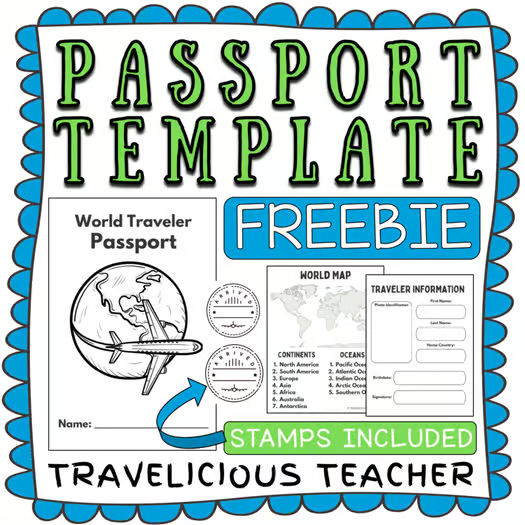
I decided to use our limited time to focus our studies on structures in France and Japan. Since we were going to pretend to travel out of the country, students made a passport book, and I introduced students to Google Earth so they’d understand how it worked.
On the day we were to leave for France, before the class arrived, I set up the desks and chairs to look like the inside of an airplane.
I had students hand me their passports before “boarding.” Once seated, I spoke to them like a flight attendant about their tray tables and electronic devices. I displayed our current location on our screen and had Google Earth fly us to our destination.

On another tab, I opened this virtual vacation site, where we had a bird’s-eye view from the plane as we were flying into Paris. While landing, I played a simulated pilot’s announcement I created using invideoAI. InvideoAI gives you a prompt box that lets you type in your request to create a landing announcement. I found the video made by InvideoAI too short, though, so I went to claude.ai and prompted there until I got what I had in mind. Then, I copied and pasted what was in claude.ai into invideoAI ‘s prompt box and asked it to generate a video. Last, I downloaded the video for free!
Once we “landed,” passport stamps were glued down. Over the next weeks, we learned about various structures in France, beginning with the Eiffel Tower. As part of our journey, we drove, via Google Earth, to the Caves of Lascaux.
We then “boarded the plane” again and experienced another simulated flight over to Japan. There, we learned about capsule hotels, Hachiko’s story and statue, and the art of origami. You can refer back to the original post to find links and information about these structures.
WRITING ABOUT OUR LEARNING
At each step of our journey, I wanted students to write about what they were learning. We titled our books Structures Around the World. Each student’s book included: (1) a cover with a world map, (2) a table of contents, and (3) a written description and illustration of each structure we studied, one student-created page for each structure.
Students did their writing after several experiences that led to their understanding of each structure. For example, when we were “visiting” Lascaux, students learned how caves are formed, they made models of caves, viewed videos, and listened to or read about the Lascaux Caves. In writing their page for the book, they were asked to include what they’d learned about cave formation and information about Lascaux.

Most of the time, students sketched their own illustration at the top of each page, but sometimes we created something that was glued in the illustration box instead. For example, on the Lascaux page, each child did a cave drawing with charcoal pencils on crumpled paper bag pieces instead of a regular illustration.
At the end of the unit, these pages were all stapled together to make a book. During the unit, I kept a file folder for each child with the loose pages of the book so they wouldn’t get wrinkled up in desks or their folders. For second graders, I used pages from this resource since it included a table of contents and a variety of choices for the cover and page formats.
FOR FUTURE TRAVELS
I plan to continue to add to this next year. We study many other things in second-grade gifted pull-out, and it would be great to see how I could integrate them into our Structures Around the World umbrella of learning.
I’d love to introduce this with a mini-unit on Pangea, the continents, and the oceans so students will have a better understanding of world geography and the sizes of and distances between places. With more time next year, I hope to strike a better balance of human-made and nature-made structures around the world.
Finally, as I continue to add to this, I want to be more intentional about the thinking they do, applying the depth and complexity tools and learning across disciplines. I know in the short time we had, they were thinking from multiple perspectives and working across disciplines, so it should be easy to reinforce these skills and strategies as we go.
| If you plan units under the universal theme of STRUCTURES and can help us add to the activities and mini-units mentioned in this post, please leave a comment below or send a message! |